- 0.60D less myopia progression achieved with ZEISS MyoActive spectacle lenses on average.2
- On average, children wearing ZEISS MyoActive lenses showed no progression of clinical relevance.2,3
- The design uses patented1 M.O.V.E. technology to generate dynamic signals to reduce adaptation and increase myopia control efficacy
October 1, 2026
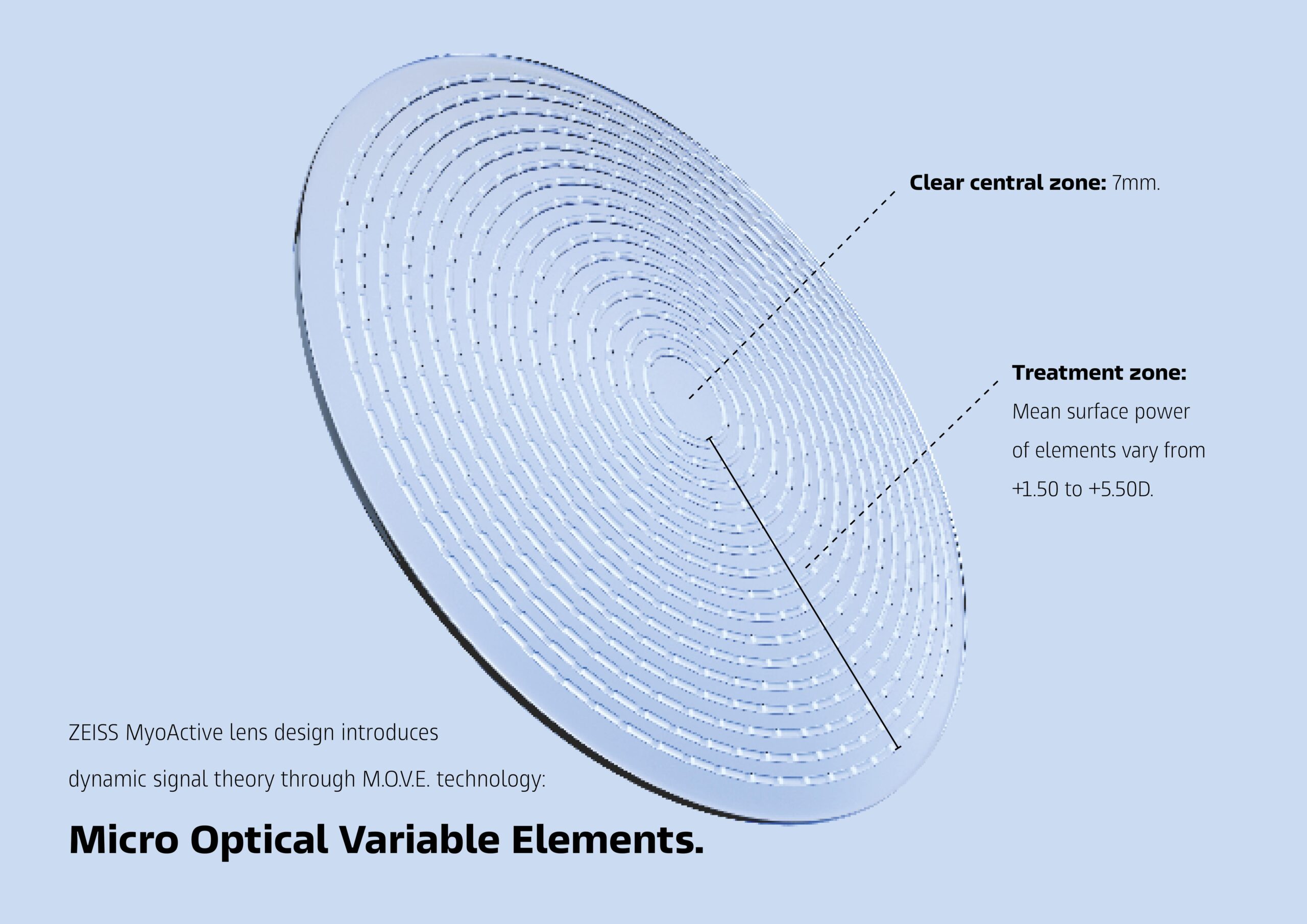
Image provided by ZEISS
AALEN, Germany — ZEISS Vision Care has officially launched a new myopia management spectacle lens, ZEISS MyoActive. The lens design applies the advanced concept of Dynamic Signal Theory through optical defocus.
Clinical evidence supports the efficacy of this differentiated approach: At 12 months, ZEISS MyoActive demonstrated the highest efficacy among myopia control spectacle lenses, with 0.60D less myopia progression and 0.22 mm less axial elongation than a single vision lens (NCT06563700).4 With ZEISS MyoActive, mean progression was -0.23D/year, which is less than the 0.25D increment step used in subjective refraction, indicating no progression of clinical relevance. In addition, 98% fully adapted to the lenses within one week. Results remained consistent across both six-month periods, supporting sustained performance.2,3
Dynamic Signal Theory
The concept behind ZEISS MyoActive lenses builds on a key challenge in myopia management: the eye and visual system can adapt to repeated, uniform optical signals over time. Dynamic Signal Theory addresses this by combining myopic defocus, which provides the biological signal to help slow eye growth, with dynamic signal variation to help maintain retinal responsiveness. In ZEISS MyoActive lenses, this principle is applied for the first time in a myopia management spectacle lens through patented1 M.O.V.E. technology.
Optical design and myopia management
The front surface of ZEISS MyoActive combines a central clear zone with patented1 M.O.V.E. technology, which stands for Micro Optical Variable Elements. This non-repetitive layout of microstructures creates continuously changing retinal signals as the eye moves naturally throughout the day. As a result, the optical signal remains active and variable rather than static, helping to reduce visual adaptation. The back surface is optimized using ZEISS ClearFocus design. It minimizes hyperopic defocus in the periphery of the lens.
The combination of a central clear zone and a treatment zone with microstructures, together with the specific back surface design, makes ZEISS MyoActive lenses ZEISS’ most effective myopia management lens to date, developed for children.2
Part of the ZEISS Myopia Management Collective
As part of the ZEISS Myopia Management Collective, ZEISS MyoActive is embedded in a broader ecosystem of evidence-based products, solutions and services, grounded in robust scientific research and continuous innovation. This portfolio is designed to guide eyecare professionals across the entire myopia journey and enable effective, sustainable myopia management for younger patients.
ZEISS, ClearFocus Design, MyoActive and M.O.V.E. are trademarks of Carl Zeiss AG and/or other companies of the Carl Zeiss Group.
Not all products, services or offers are approved or offered in every market and approved labelling and instructions may vary from one country to another.
References
1 WO 2025/098939 A1
2 Two-year prospective, multi-center, double-blind, randomized controlled clinical trial (NCT06563700) by Shanghai Eye Disease Prevention and Treatment Center, China, 2025. Myopic children aged 7-13 years wearing ZEISS MyoActive (N=56) and myopic children aged 7-13 years wearing ZEISS Single Vision Rx lenses (N=56), one-year results as of July 2026, data on file.
3 Mean progression with ZEISS MyoActive <0.25D which is the smallest measurable change in prescription of clinical relevance.
4 The ongoing randomised controlled trial (NCT06563700) enrolled 342 myopic children across three sites in China, assigning them to five test spectacle lens (SPL) designs or a single-vision (SV) control Group.
Read more of the latest myopia news here