April 14, 2026
By Cécile Clavier, Global Senior Director, Pediatric Business Unit, HOYA Vision Care

Photo Credit: Getty Images
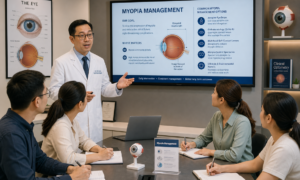
When I look back at the last decade in myopia management, what stands out most isn’t just the evolution of clinical guidelines; it is how the recognition of evidence-based therapies is reshaping the discussion between Eye Care Professionals and the families they serve. This shift is fostering trust and enabling more open, confident discussions about children’s vision care.
We’ve seen truly remarkable global progress, supported by organizations like the International Myopia Institute (IMI) and local endorsements from bodies ranging from the College of Optometrists in the United Kingdom to consensus statements published in peer-reviewed journals in China. But the change I find most exciting is seeing how these insights are being translated into daily action that benefits children.
The Evolution of Myopia Management Discussions
Almost nine years ago, when our team introduced MiYOSMART,* the discussion around managing myopia was still tentative. Today, management is commonplace – and continuing to advance, with MiYOSMART iQ ushering in a new era of myopia control wherein no myopia progression on average could be reached.1 This transition has been driven by several factors: practitioners gaining the confidence to recommend early intervention, parents realizing that waiting is no longer the answer and innovative solutions backed by robust clinical evidence becoming readily available.
The beauty of this progress lies in thoughtful local adaptation. It is not about a one-size-fits-all approach; it’s about innovation that respects regional health care systems while maintaining the highest standards of care. For instance, in markets like France, the inclusion of MiYOSMART within the national social security reimbursement framework has firmly reinforced Defocus Incorporated Multiple Segments (D.I.M.S.) Technology as a first-line myopia management option. This policy, coupled with increased public awareness, has helped normalize early intervention for both ECPs and families. In other markets, we are seeing combination treatments become the norm for children with more complex cases.
At HOYA Vision Care, we are deeply committed to supporting this evolution. Our involvement with IMI, WHO SPECS2030 initiative, our local educational initiatives and our partnerships with ECPs are all driven by one core belief: every child deserves clear vision, and every ECP deserves the tools and confidence required to deliver it. The guidelines provide the foundational framework, but it’s the dedicated care and craftsmanship in our support—through training, resources and an engaged community—that truly makes the difference.
The Maturation of the Myopia Market
When we launched MiYOSMART in 2018, we were pioneering a new category of care. I remember ECPs were understandably cautious; there was limited long-term data available, and the prevailing attitude was often “wait and see.”
The landscape has since transformed. Today, ECPs are not just accepting research; they are actively seeking it out, sharing findings with their peers, and leveraging it to have confident, evidence-based conversations with parents. This shift from a niche area to a core competency is profound. We are incredibly proud to back this confidence with our own evidence, unveiling the most impressive myopia control results seen so far with our new D.I.M.S Technology-based spectacle lenses, MiYOSMART iQ.1 This new innovation builds on our clinically-proven MiYOSMART spectacle lens, which is now backed by eight-year data2 demonstrating its impact on myopia progression—the longest-running clinical trial of a myopia management spectacle lens to date.
A few key insights have served as true game-changers in how ECPs approach care:
First, early intervention matters. We now understand that myopia progresses faster in younger children,3 and acting early can dramatically improve long-term visual outcomes. MiYOSMART iQ now makes this possible from as young as four years of age1, where the stakes of early myopia onset are high. This knowledge has changed ECPs’ conversations with parents, moving them from suggesting, “Let’s wait a year,” to advising, “Let’s act now.”
Second, personalized, flexible approaches are essential. The introduction of combination treatments, such as pairing MiYOSMART spectacle lenses with low-dose atropine, shows a more sophisticated understanding of individual needs.4 When we first presented our early work on combination therapy at IMI 2022, the response was enthusiastic, and it has since become a cornerstone of clinical decision-making for complex cases.
Third, we must advocate for holistic care, not just treatment. Children need to feel confident throughout their treatment journey, which is why a holistic approach—one that encourages outdoor time and considers broader lifestyle factors—aligns so closely with our philosophy. Practical product features, such as the photochromic technology in MiYOSMART Chameleon or our advanced hydrophobic STX coating, further support children in their everyday activities and encourage more time outdoors. Our goal is to partner with families to protect their child’s vision journey, not just sell a lens.
Our work at HOYA Vision Care includes an evidence base of over 100 scientific publications on D.I.M.S. Technology. While these numbers build credibility and trust, it is the community we have built that matters most. Through our Confidence in Practice campaign, the MiYOSMART Case Study Contest and platforms like the HOYA Learning Centre, we are creating spaces where ECPs can learn, share and grow together.
Amplifying Knowledge for Clinical Integration
How do we ensure that every ECP—and every family—has access to the information they need in a way that is practical, engaging and empowering?
Busy ECPs cannot afford to wade through dozens of peer-reviewed papers. They need tools that distill research into clear, practical guidance. This is the mission behind initiatives like Confidence in Practice, which equips ECPs with parent-friendly materials, communication frameworks and decision-making tools grounded in evidence.
Ultimately, this work is about helping children thrive in their daily lives, whether they are trying to see the board in the classroom or simply engaging confidently with the world around them. That is the vision that drives us, and it aligns perfectly with our company’s purpose to “improve life through vision,” while making vision care accessible to all.
*Product Disclaimer: MiYOSMART spectacle lenses have not been approved for use in the management of myopia in all countries, including the U.S., and are not currently available for sale in all countries, including the U.S.
 |
Cécile Clavier is the Global Senior Director, Pediatric Business Unit, at HOYA Vision Care. |
References:
- Tse DYY, et al. Myopia Control Efficacy of Defocus Incorporated Multiple Segments Triple Enhanced Design Spectacle Lenses. The 41st Asia-Pacific Academy of Ophthalmology Congress, February 5–8, 2026. Abstract 205567. https://2026.apaophth.org/abstract/?code=205567 (Accessed: March 2026)
- Leung TW, et al. Comparison of Myopia Progression in Individuals Wearing Defocus Incorporated Multiple Segments (DIMS) Spectacle Lenses for Eight Years versus Shorter Durations. Abstract presented at ARVO. Available at: https://www.hoyavision.com/globalassets/__regional-assets/global/arvo-2025/leung-et-al.-dims-8y-study-arvo-2025-abstract.pdf (Accessed: March 2026)
- Moore M, et al. Myopia progression patterns among paediatric patients in a clinical setting. Ophthalmic Physiol Opt. 2023;44:258–69.
- Guemes-Villahoz N, et al. Atropine and Spectacle lens Combination Treatment (ASPECT): 12-month results of a randomised controlled trial for myopia control using a combination of Defocus Incorporated Multiple Segments (DIMS) lenses and 0.025% atropine. Br J Ophthalmol. 2025;109:1074–80.