September 28, 2026
By Michael Dittman, OD

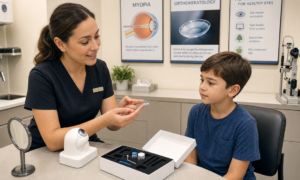
Image generated with AI
After 25 years of practicing optometry, I have become comfortable with making diagnoses and forming treatment plans. An example of this is when a patient comes in with IOPs in the mid 20’s and has a cup to disc ratio of 0.80. I discuss glaucoma, the prognosis, testing needed and the potential treatment. In this scenario, almost 100% of the time, the patient agrees and follows the protocol that is recommended.
But when the scenario changes and the patient is now 7-years-old, a –1.50D in each eye and two myopic parents, the path forward seems obvious to me. This is the classic case that every myopia management lecture is about. This should be a slam dunk for early intervention.
For this child, I proceed to walk the parents through the findings just as I would for the glaucoma patient. I will explain the risks and outline the options. The parents nod in agreement. They listen intently. They seem to be processing everything exactly the way I had hoped. I’m already mentally planning the follow-up schedule and the treatment plan.
Then, when I ask for their thoughts, they smile politely and say: “No thank you — we’re just going to get them glasses.”
In that moment, I sit there dumbfounded. A little frustrated. A lot confused.
Navigating Fear
Where did I lose them? What didn’t land? How did a clinically obvious decision turn into a polite refusal?
This scenario isn’t rare. Unfortunately, it’s common, and it’s deeply revealing. It forces us to confront a truth we don’t always talk about. Sometimes clinical care and decision-making do not follow the same rules. Parents aren’t necessarily rejecting science. They’re navigating fear, uncertainty, cost and many other automatic thinking patterns.
Understanding why this happens and how to communicate more effectively is now just as essential as understanding axial elongation curves or treatment efficacy data in the world of myopia management.
The truth is: Knowing the science of myopia management is non-negotiable, but the science of helping parents say yes may be just as important.
Why do parents often default to glasses?
To many, myopia does not feel like a disease. It feels more like an inconvenience that can be corrected with glasses, contacts or even LASIK someday. And then, when one doctor prescribes glasses without mentioning long-term risks, and another introduces myopia management with added cost and complexity, parents experience a confusing mismatch that makes myopia management feel optional or even unnecessary.
The parents’ uncertainty is reinforced by the fact that the most serious complications of myopia—retinal detachment, early cataracts and myopic maculopathy—are decades away, far outside the time horizon most parents use when making decisions for a young child or for themselves. As a result, they interpret myopia as a short-term nuisance rather than a vision threatening disease.
This blend of uncertainty and inconsistent provider messaging ultimately strengthens the perception that myopia management is optional rather than essential. Glasses feel familiar, safe and sufficient, while myopia control feels new and not needed.
Engaging Parents From The Beginning
So, how do we, as optometrists, communicate in a way that truly shifts how a parent thinks about myopia?
The first step is making sure the parent is actively engaged from the very beginning. I start with an open-ended question that invites them into a learning conversation: “Before I start the exam, can I ask you a quick question? What have you noticed recently about your child’s vision?” Their answer gives me insight into their perspective.
After they answer the question, I thank them, to reinforce that their observations matter. After completing the exam, I pause briefly to review the data, a moment that signals expertise and builds authority and then validates their concern:“You were absolutely correct to notice your child having trouble seeing. Today’s findings show they are already myopic, or nearsighted.”
This step is important in making the parents an active part of the decision team and gets everyone aligned, which naturally reduces resistance.
Next, I will introduce objective data. I use growth charts to allow parents to see where their child falls compared to peers and how their myopia is projected to progress. Visual data is powerful because it makes the future feel concrete rather than abstract.
Finally, I show how those projections change when we begin myopia management. In most cases, this is the moment when parents shift from viewing myopia as a simple inconvenience to recognizing it as a condition that deserves proactive care. Many parents become fully invested and schedule a consultation immediately.
For those who need more time to process, we provide a customized handout summarizing all the data we reviewed and follow up with a phone call– a step that supports thoughtful decision-making.
Embracing Proactive Care
Ultimately, the challenge in myopia management is not simply identifying early myopia, it is helping parents understand what that diagnosis truly means. Parents default to glasses because the condition feels familiar, low-risk and easily corrected. And because inconsistent messaging across providers reinforces the belief that additional treatment is optional.
When we engage parents with open-ended questions, validate their observations, present objective growth-chart data and visually demonstrate how early intervention changes long-term outcomes, we shift the conversation from inconvenience to prevention.
This structured approach not only earns genuine buy-in but also positions optometrists to lead families toward decisions that protect their child’s future vision. In the end, effective myopia management is as much about how we communicate as what we prescribe. When those two elements align, parents are far more willing to move beyond “just glasses” and embrace proactive care.
 |
Michael Dittman, OD, is the founder of Dittman Eyecare and The Myopia Matters Club. He started Dittman Eyecare in 2003 with one doctor and two staff members, and grew the practice to having four doctors, 25 team members, and three locations north of Pittsburgh. Dr. Dittman also founded The Myopia Matters Club, which is a separate branch of the office solely focused on myopia management services for children who are myopic or high risk to become myopic |
Read more practice management articles here