September 15, 2026
By Sabrina Gaan, OD

Photo courtesy of Maskot/Getty Images
I graduated from the Illinois College of Optometry in 2009 and started my career as an associate at a private practice, where I spent a decade honing my clinical skills. It was during this time that I first became involved in myopia management. I took over the myopia program from a retiring doctor, which at the time consisted solely of ortho-k treatment. The experience wasn’t easy—there weren’t the resources and tools we have today—but it sparked a real inspiration in me.
After 10 years, I realized it was time to branch out on my own. I subleased a space at a Pearle Vision, where I stayed for two years, but quickly outgrew it. I wanted more room and opportunities to expand the services I was passionate about, so I purchased a private practice whose previous owner was relocating from Massachusetts to Maine. The practice was in a low-to-moderate income area, valued at $750,000 and I grew it to $1.9 million in the first year alone.
From the beginning, I wanted to do more than just routine eye care. I introduced dry eye treatments, expanded medical optometry services and refreshed our frame lines. Myopia management was a natural extension of my vision for comprehensive, patient-centered care.
Building the Program
Initially, I focused on figuring out the logistics—which treatments to offer, how much we would charge and how to present them to families. We offer Paragon CRT OrthoK lenses and CooperVision MiSight lenses. For children with higher astigmatism, we use Biofinity toric multifocal lenses. Ortho-k remains our most popular treatment, though MiSight has been gaining traction.
I’ve chosen not to offer low-dose atropine eye drops because I don’t particularly like them. They bring too much variability, and from personal experience, they can be uncomfortable for children. Once on vacation, I saw a friend’s child struggling with extreme light sensitivity at the beach from atropine. I don’t want that for my patients and I have found stabilization without it.
Once I decided on treatments, I focused on creating a program that made sense for families. I eventually decided to establish a global fee of $2,000 for the first year. This covers everything: the initial assessment, the selected treatment and follow-up visits at one week, one month and six months. After that, annual visits are treated as premium contact lens evaluations, with families also paying for replacement lenses.
This approach simplifies care for families and allows us to provide consistent, high-quality management without confusion over costs. The global fee also balances differences between treatments—MiSight lenses are easier to fit but more costly, while ortho-k lenses require more time and customization but are less costly.
Facing Hesitation and Cost Concerns
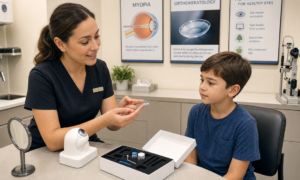
Not every family immediately embraces myopia management. Many initially don’t understand why myopia management is important or worry about the cost. I always walk the group through how myopia develops and progresses, the benefits of treatment and what to expect, answering questions so they see the program’s value for their child.
Some parents take some convincing to come around. For instance, I recently saw a 9-year-old whose mother was hesitant. Her child was already at a -2, while she was a -7 herself. Once she grasped the implications of going without treatment, she enrolled her child in the program.
Not every family decides to participate. I recently saw a case where a mother did not want to discuss myopia management at all. Her hesitation stemmed from both cost concerns and a limited understanding of myopia—a challenge much like what parents face with braces, where the value may not be obvious and the cost can be daunting. While you can’t sway every parent, I focus on providing clear information and support so families can make informed decisions. Many times, parents ultimately sign up the following year after seeing their child progress further.
Although not every family opts in, those who do are often our best advocates, referring us to other parents with children in the same boat. In fact, most of our patients come through these parent-to-parent recommendations. Social media also helps us reach families. Using keywords like “pediatric eye care” and “myopia management” allows us to educate parents early, making conversations about treatment more productive.
Connecting Research, Experience and Family Care
Staying informed is critical in a field that evolves so quickly. Myopia management looks a whole lot different today than it did even five years ago. I turn to Review of Myopia Management, the American Optometric Association and The Myopia Collective to keep up with new research and treatment approaches, ensuring that all my patients receive care grounded in the latest evidence.
Having two children of my own, one of whom is myopic, reinforces the importance of what I do. My perspective as a mother helps me connect with families and guide them through decisions with empathy and clarity. I understand the concerns parents face and the desire to make the right choices for their child.
At Eyes on Plainville, myopia management is more than a service—it’s part of our philosophy. Our goal is to give every child the clearest vision possible today while protecting their eye health for years to come. By combining comprehensive care, evidence-based treatments and a patient- and parent-first approach, we help families take proactive steps to preserve their children’s vision as they grow.
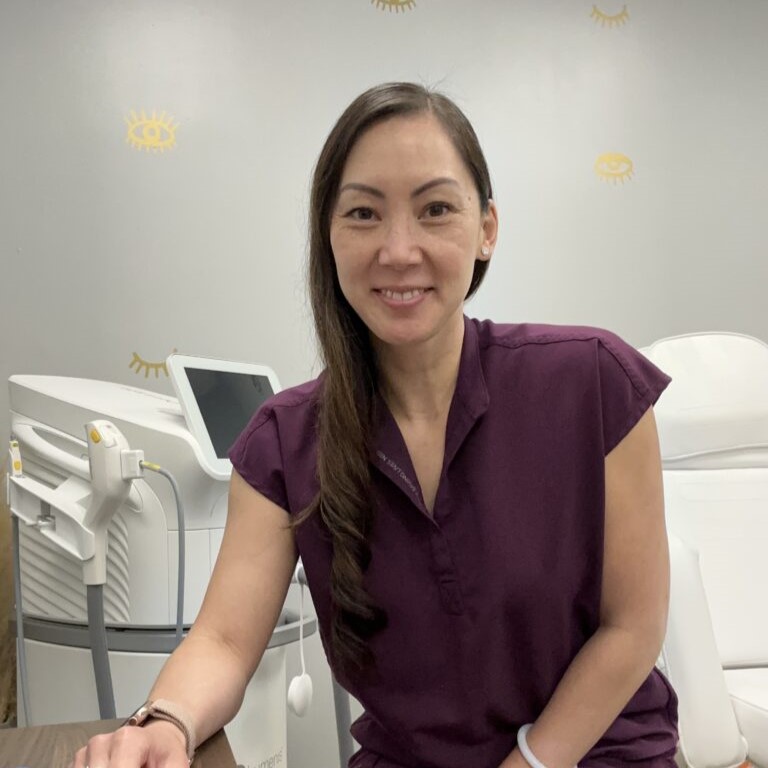 |
Sabrina Gaan, OD, is the owner of Eyes on Plainville in Plainville, Massachusetts. You can find her on Instagram: @dr.sabrinagaan |
Read more practice profiles here.