All photos courtesy of Georgia Lions Lighthouse Foundation
The Georgia Lions Lighthouse Foundation (GLLF), a program that screens students, performs on-site exams and fits children with prescription glasses, has grown the reach of its mobile school clinic.
Leaders of the program, including Beth Ehrhardt, Executive Director of the GLLF, Mark Dickinson, OD, and Jamal Greene, Mobile School Clinic Director, highlight how the Mobile School Clinic brings complete eyecare directly to schools. One of the biggest benefits: reducing transportation and work-related barriers for families and ensuring high follow-through for children who need corrective lenses.
How Does The Mobile School Clinic Work?
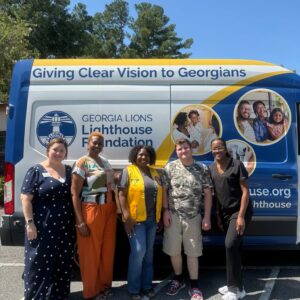
The GLLF mobile clinic
The mobile school clinic currently serves elementary students ages 5 to 12. Dr. Dickinson says, “Children often don’t know they have a vision problem and won’t tell their parents. By starting in elementary school, we get them on the right foot. Our program provides a near 100% guarantee that kids who need glasses will get them.”
The program integrates screening, pretesting, examinations and eyewear distribution at elementary schools. After initial screenings, clinic staff provide pretesting and exams in a separate room. When a child needs glasses, the GLLF laboratory makes the lenses, and the program returns the glasses to the school once they’re ready.
The clinic team can screen an entire school in roughly three hours with minimal classroom disruption. The process uses portable autorefractors and other mobile equipment to accelerate screening. “In some screening events, teams screen about 500 children in a morning,” Director Greene says. The program shifted from issuing vouchers to delivering finished glasses after GLLF funders insisted on “glasses on faces.”
Director Greene says schools report improved behavior and grades a few months after eyewear delivery. The program is pursuing formal research to quantify academic improvements. Director Ehrhardt says students from Augusta Medical University and Emory University have assisted with a study of screening and follow-up practices across school districts. That research has supported legislative discussions on expanding screening for children.
Staffing, Training and Equipment Challenges
Director Greene and Dr. Dickinson emphasize the need for more optometrists and technicians. They recruit volunteers and staff through conferences and online postings, but Director Greene says legislative support and more doctors are the program’s biggest needs.
Dr. Dickinson noted a statewide shortage of optometrists and added that some doctors hesitate to work outside traditional clinic settings. “I try to educate them that with a little practice and motivation, they can easily adapt their skills to this environment,” Dr. Dickinson says.
Director Ehrhardt says the program will continue addressing staffing and capacity. Donor support funded additional vans: two for teleoptometry and two for traditional clinics. The organization applied for a grant to outfit five traditional mobile lanes, which would allow five doctors to work simultaneously in one school. Two optometrists will join the staff as employees in the summer, Director Ehrhardt says.
Partnerships and Expansion
Sight for Kids: GLLF partners with Johnson & Johnson
The Mobile School Clinic and KIA began their partnership after an introduction at a 2022 fundraising event. Gary Stoken, the president of the Peach Bowl, had a KIA board member who expressed interest in KIA supporting GLLF. The program started screenings in January 2023 and added on-site exams and eyewear distribution by fall 2023. Director Ehrhardt says the KIA relationship enabled expansion from Atlanta public schools into the broader metro Atlanta area.
Johnson & Johnson and Lions Clubs International Foundation’s co-founded Sight For Kids program accelerated scale and expanded vision care services for children to five new counties. The Sight For Kids program provides complete eye healthcare for students through Lions-led screenings, on-site clinic examinations, and spectacle distribution.
Director Ehrhardt has met with state legislators to promote mandatory early screening and better screening tools. She says a bill requiring screenings for pre-K through third grade is slated for the governor’s signature. The organization also supports portable autorefractors and broader screening policies. Dr. Dickinson noted a bill for a new optometry school in Georgia passed this year, which could ease long-term staffing challenges.
What’s Next For GLLF?
The mobile school clinic plans to recruit more doctors and technicians, add vans and clinic lanes and expand services into additional counties in Georgia. The team will continue legislative outreach and pursue research to document academic and behavioral outcomes after eyewear delivery. The program seeks volunteer doctors, technicians and financial support to increase reach and staffing.
Read about GLLF on Review of Optometric Business here.
For more of our public health articles, click here.