September 28, 2026
By Nicholas Despotidis, OD, FAAO, FOVDR, FIAOMC
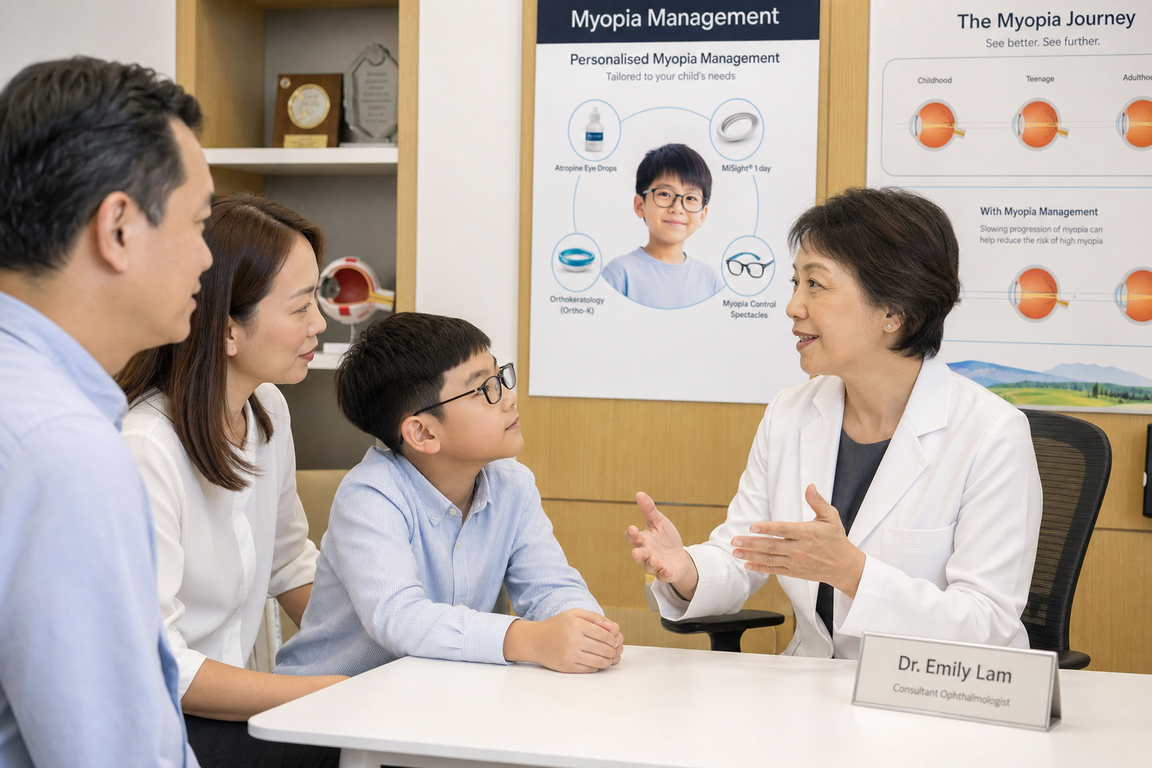
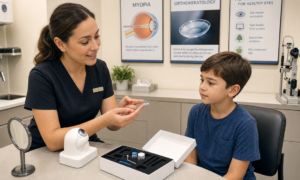
Image generated with AI
When I look back at how my approach to myopia management has evolved over the years, surprisingly few turning points came simply from reading an article or listening to a lecture.
They came from people.
A conversation that challenged a long-held belief. A hallway discussion with a colleague sharing a mistake that saved me from making the exact same one. Or watching another practitioner approach a familiar fit in a way I had never considered.
In our post-COVID era, I find those opportunities harder to cultivate. Virtual education has given us tremendous access to information, and I certainly appreciate its convenience. But I also think we lost something when we stopped spending as much time together.
We lost some of the conversations between the lectures.
I’ve been involved in myopia management for a long time, but I still walk into meetings expecting that someone in the room knows something I don’t. That humility and curiosity have served me well.
And perhaps they are more important today than ever. Myopia management continues to evolve rapidly. New spectacle designs have expanded our treatment options. Soft multifocal contact lenses and orthokeratology continue to evolve. Pharmacologic treatments continue to be investigated. Axial length measurement has changed how many of us monitor progression.
The science is changing. The technology is changing. And hopefully, so are we.
Here are five lessons that have shaped the way I practice today.
-
The Best Growth Strategy
Early in my career, I thought practice growth was primarily about patient acquisition.
Busy translated into successful.
Like many doctors, I focused on marketing, referrals and getting more families through the door. Those things have their place, but over time I began to realize that I was asking the wrong question.
The most sustainable growth in our practice has come from taking extraordinary care of the families who have already trusted us.
That may sound cliché, but in an age of automation and artificial intelligence, I believe it matters more than ever.
In myopia management, exceptional care means going far beyond successfully fitting a lens or prescribing a treatment. Parents need to feel that we truly know their child, that we are carefully monitoring their progress and that we will be there when challenges arise.
When families experience that level of care, something happens: they talk.
The referral becomes the natural byproduct of the care rather than the primary objective.
So today, instead of asking, “How do I get more myopia patients?” I ask: “How do I deliver such exceptional care that families rave about it?”
That change in thinking has probably done more for the growth of our myopia management practice than any marketing strategy I have tried.
-
The Fit Is the Beginning, Not the Finish Line
Earlier in my myopia management career, I spent an enormous amount of energy thinking about the initial treatment.
Which lens? Which design? Which atropine concentration? What was the best treatment for this particular child?
Those questions remain important. But I eventually realized that I was becoming remarkably sophisticated at starting treatment without giving nearly as much thought to what happened afterward.
The initial treatment decision is merely the opening chapter of a long relationship.
Myopia management is measured in years.
What happens in year two or three? What do you do when axial length continues to increase? How do you adapt when a child’s lifestyle changes or compliance declines? When should you modify treatment? And how do you keep families engaged when everything is going well?
That last question may be one of the most important.
When treatment is successful, it can become almost invisible to the family. The child sees well. The parents aren’t worried. Life moves on. Yet our responsibility to monitor remains paramount.
That realization changed the systems in our own practice. Recall, communication and long-term retention became part of the treatment itself rather than administrative tasks surrounding it.
I had become remarkably sophisticated at starting myopia management.
I needed to become equally sophisticated at maintaining it.
-
Know the Evidence—But Know Its Limitations
Earlier in my career, I probably wanted the literature to give me clearer answers than it could.
Which treatment works best? At what point should I change course?
The scientific foundation of myopia management has advanced enormously. We have evidence supporting orthokeratology, soft multifocal contact lenses, low-dose atropine and advanced spectacle designs. We can measure axial length and map corneal shape with remarkable precision.
Studies tell us what happened to a population under specific conditions.
Sitting in our exam chair is one child.
Behind that child are parents with their own expectations, financial realities, busy schedules and tolerance for risk. What happens when that child struggles? What happens when treatment doesn’t go as expected?
These aren’t exceptions to myopia management. They are the realities of caring for children and families. How we respond to those moments can make or break a program.
Our responsibility is to understand the evidence well enough to translate it into a thoughtful, personalized recommendation for the family in front of us.
Evidence should inform our decisions, not make them for us.
Interestingly, the more I’ve learned about the science, the more comfortable I’ve become acknowledging both what we know and what we still don’t know.
Parents respect that honesty. They respect a doctor who sees beyond their child’s vision, who takes the time to listen and who genuinely cares about their child.
And in my experience, families return that respect by supporting our practices in ways that aren’t always immediately measurable.
-
Colleagues Will Shorten Your Learning Curve
Some of the most valuable insights I’ve gained at conferences were never listed on the educational agenda.
They happened over coffee, walking between lectures or standing in an exhibit hall discussing a difficult case with another doctor.
Those conversations matter because colleagues will often share something that rarely makes it onto a lecture slide:
What didn’t work.
This became particularly apparent to me during the years when so much of our education became virtual.
Nearly everything being presented seemed to be perfect.
The perfect topography. The perfect fit. The perfect result.
Then I would return to my clinic, and sometimes things didn’t go according to plan.
It was easy to wonder: Am I doing something wrong?
Talking openly with colleagues taught me otherwise.
Everyone struggles. Everyone has tried things that didn’t work. Everyone has had a conversation with a parent they wish they could redo.
Those stories simply don’t make it onto PowerPoint slides very often.
When you sit across the table from colleagues, they tend to be more transparent.
Learning from someone else’s success is valuable.
Learning from their mistakes can be priceless.
I’ve made plenty of my own over the years. Whenever possible, I’d prefer not to repeat someone else’s.
Being able to turn to a colleague and ask, “How are you handling this in your office?” can shorten your learning curve by years—and sometimes prevent a very expensive mistake.
Perhaps that is what I miss most about the way we learned before COVID. Information has never been easier to obtain. But information and wisdom aren’t always the same thing.
-
Technology Matters Most When It Changes How We Care
I love technology. I always have. And now, with artificial intelligence, technology is transforming the way I practice in ways I couldn’t have imagined even a few years ago.
Topography, optical biometry, sophisticated lens-design software and other technologies have dramatically expanded what is possible in myopia management.
But over the years, I’ve learned an important distinction: owning technology and using it meaningfully are two very different things.
Optical biometry is a good example.
Like many doctors who practice myopia management, I measure axial length. But my use of that information has evolved.
Parents often ask if their child’s eye length changed. That question forced me to become better at explaining what I was measuring—and, equally important, what an individual measurement could and could not tell me.
Eventually, I began creating customized reports, with the help of AI, that I use during consultations and progress evaluations. I don’t want parents looking at an axial length measurement. I want them to understand the trend, why I am monitoring it and how it contributes to the decisions I make about their child’s treatment.
The technology didn’t change. How I used it did.
Technology can give us more information than ever before. Artificial intelligence will undoubtedly give us even more.
But more information isn’t necessarily better care.
What matters is what we do with it.
Growth
After decades in practice, I am more convinced than ever that none of us figures this out in a silo.
Nearly every meaningful breakthrough in my own career can be traced back to someone—a mentor, colleague, researcher or conversation that caused me to think differently.
Many of those relationships started at industry events like Vision By Design.
I don’t attend industry events expecting five magic bullets that will transform my practice overnight. I go hoping to learn one new thing and connect with someone who sees a familiar problem through a different lens.
Maybe that matters even more today.
We have access to more research, webinars, podcasts, Substacks and online education than at any other point in our careers. Information is everywhere.
But sometimes the thing that changes your practice isn’t another piece of information.
It’s the conversation afterward.
Conferences and symposia don’t simply teach us something new.
They change what we do when we walk back into our practices on Monday.
For a sample consultation report from Dr. Despotidis, click here.
 |
Nicholas Despotidis, OD, FAAO, FCOVD, FIAO, has one of the largest practices in the country specializing in myopia management. He’s the lead author of two books, My Children are Nearsighted Too and A Parent’s Guide to Raising Children with Healthy Vision. His workshop SuperChargeYourPractice is the most sought-after practice management course offered at the Vision by Design symposium. His TEDx talk “A Childhood Disease Worth Preventing” educates parents on the growing number of children affected by myopia and possible treatments available to them. Learn more about Dr. D and contact him here. |