September 8, 2026
By Vishakha Thakrar, OD, FAAO, FSLS
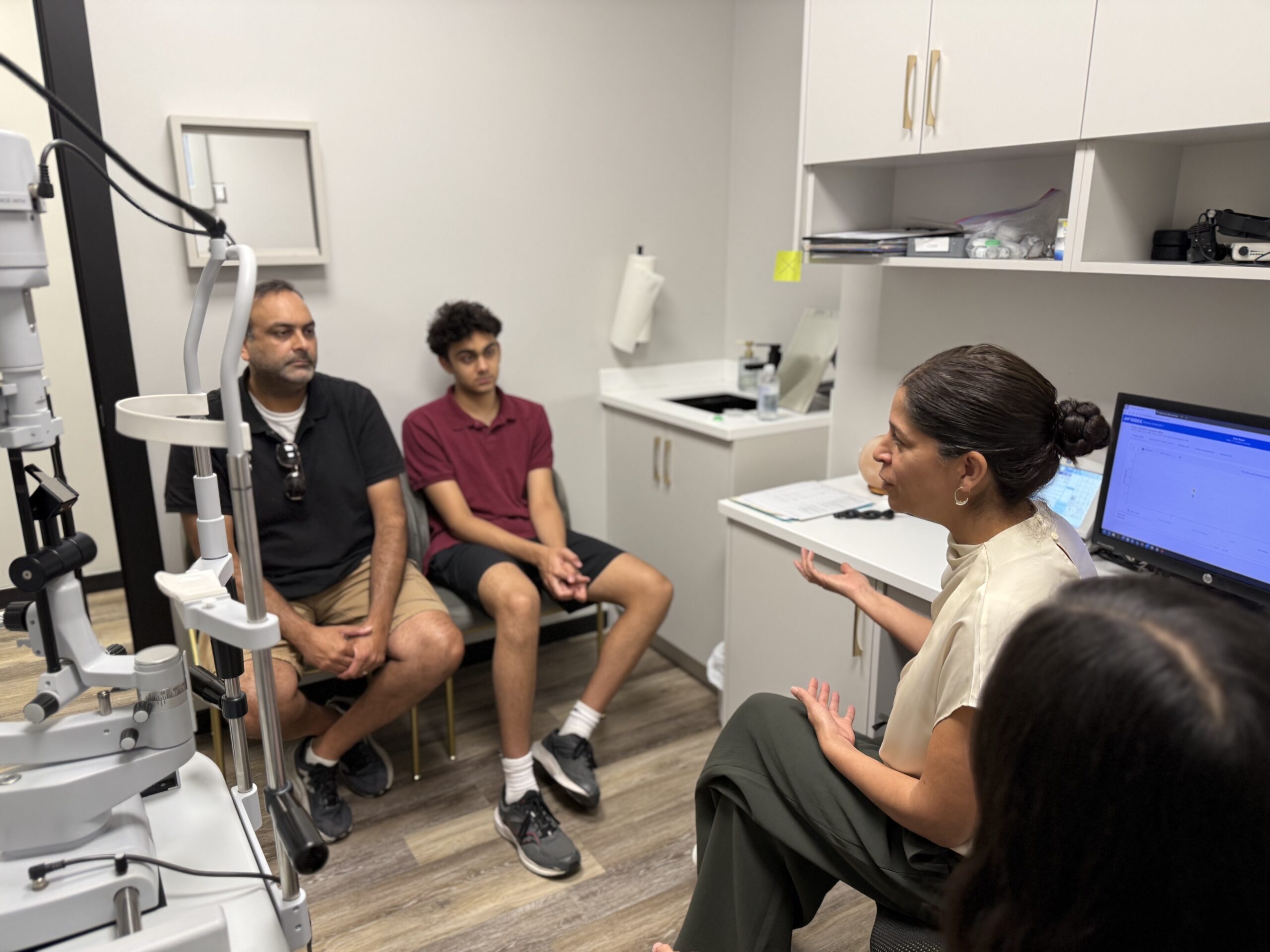
Dr. Thakrar explains the value of myopia management to her patients and their families. Photo provided by Dr. Thakrar
Every practitioner who manages myopia has encountered an ideal candidate for myopia management, only to have the parents decline treatment. This decision can be frustrating for practitioners who understand the significant long-term benefits that myopia management can offer the child.
There can be a variety of reasons as to why the parents deny treatment. As practitioners, we need to understand the concerns that lead families to decline treatment and determine how we can better educate parents to make informed decisions about their child’s myopia management.
Expansion Beyond Contact Lenses and Atropine
In the past year, our U.S. colleagues have experienced the benefits of the launch of myopia management ophthalmic lenses. As Canadians, we know that this can change the landscape completely.1,2 It becomes much easier to prescribe myopia management therapies, particularly to those who denied the treatment in the past.
In my experience, much of the resistance to myopia management came from parents who were not comfortable putting contact lenses or atropine in their children’s eyes at young ages. They did not feel that an intervention was necessary if it required long-term medication or contact lenses. Myopia management glasses helped bridged this gap and expanded the number of practices prescribing myopia management treatments.1
Glasses are familiar and non-invasive to many parents, particularly for younger children. Prescribing spectacles gives us the opportunity to treat children whose parents may have otherwise declined treatment altogether.
Are Parents Aware of the Science?
Resistance often occurs because the parent does not understand why myopia management therapy is necessary. A thorough family history of myopia and assessment of environmental and lifestyle factors can help parents comprehend their child’s individual risk.
In our office, we educate patients and their parents based on our own clinical success with the technologies we prescribe. We back up our recommendations with peer-reviewed papers either electronically or in a package to hand to patients. We provide data from myopia progression calculators for parents who remain resistant. This way, even if the family is not ready to proceed, they have credible information to review and are almost always more compelled to proceed in the future.
Discussing the Diseases Associated with Myopia
One of the challenges with discussing myopia management is that parents may not perceive an immediate benefit. Education associated with myopia, including myopic macular degeneration, retinal complications, glaucoma and cataracts may be necessary. For many parents, understanding that our concern is for their child’s future eye health and vision may change the conversation. This discussion allows parents to build trust in you and your recommendation.
I often share that the Canadian Association of Optometrists (CAO) and the World Council of Optometry (WCO) consider myopia management the standard of care for all at-risk patients.3,4 The CAO states that myopia should not be regarded merely as a refractive inconvenience. It identifies myopia—particularly high myopia—as a global public-health issue and notes that there is no “safe” level of myopia, because even lower levels are associated with increased ocular-disease risk.3,5 I find this to be a powerful discussion point to help parents understand the reason why myopia management is important for their child.
The Choices Can Be Overwhelming
When we take genetics, environmental factors, age and lifestyle into account, we can make a solid recommendation for the patient. I discourage practitioners from simply giving parents multiple options and asking them to choose. It can become overwhelming, and in the end, the parents may decide to do nothing.
I prefer to make a strong recommendation based on what I believe is best for that child. If I sense that the parent does not agree with my recommendation, then I will discuss other options, but I will gear the choices towards the child’s lifestyle.
For example, if a young child is just entering myopia management, I will almost always recommend myopia management glasses. However, if the child is a competitive athlete, my recommendation may shift toward orthokeratology or soft myopia control lenses. Lifestyle considerations allow the practitioner to customize the treatment for the individual child and more effectively partner with the family.
Price Concerns
Likely the most common reason for pushback on myopia management is cost. In my experience, parents will often do anything they can for their children. They may spend more on treatment for their child than they would for themselves. That being said, some families have limited options. Lower-income families may be working within a strict budget, and although they want to do the best for their children, the cost of treatment may be a barrier.
So how can we help them?
In my practice, we often split up payments. A patient may not be able to pay for a full myopia management package upfront, so we may charge per visit. We may also split the cost of glasses into a deposit followed by one or two payments prior to pick-up.
With contact lenses, instead of purchasing an annual supply, families may purchase three or six months at a time. The contact lens manufacturers have aided this process by offering sizable rebates.
Alternatively, financing programs may allow the cost to be paid over a longer period of time, eliminating a large upfront expense. For many families, paying $80 per month is much more manageable than paying $1,000+ all at once.
We need to work with the family, so cost is not the limiting factor on whether a family proceeds with myopia management therapy.
Team Education and Consensus
It is extremely important that the myopia management message to the patient is consistent throughout the practice. In our practice, we provide education to all team members.
We also have more than one Myopia Management Champion. This ensures that more of our team members know the ins and outs of myopia management protocols, and can be very helpful when it comes to patient and parent education. If a particular treatment is recommended, the team will educate the patient on the treatment and its benefits. This also provides cohesion throughout the practice. If the messaging in the practice is disjointed, it can confuse patients and they may not proceed with myopia management.
Turning ‘No” into ‘Yes’
Ultimately, when parents repeatedly decline myopia management, our job is not to pressure them. Our job is to understand why their decision is not aligning with our recommendation so can we address their concerns. My experience over the past 15+ years of prescribing myopia management treatments has shown me that education, conviction and passion will often convert the most resistant parents.
 |
Dr. Vishakha Thakrar is the founder of Vaughan Vision Centre, an advanced specialty contact lens clinic, myopia, and dry eye clinic in Vaughan, Ontario. The practice focuses primarily on scleral lenses fitting, full-scope myopia management, vision therapy, and advanced dry eye treatment. Dr. Thakrar completed a Cornea and Contact Lens Residency at the New England College of Optometry. She then went on to become the Director of the Contact Lens Service at the Cole Eye Institute, Cleveland Clinic. She later helped establish the Contact Lens Clinic at the Kensington Eye Institute in Toronto. Dr. Thakrar has been fitting OrthoK lenses, scleral lenses and treating ocular surface disease for over 20 years. She is a Fellow of the American Academy of Optometry and the Scleral Lens Society. She has spoken and written extensively for many years on contact lenses, dry eye disease, corneal disease and myopia management. |
References
- Chow AHY, Caffery B, Guthrie S, Acs M, Di Marco A, Fromstein S, Ramdass S, Thakrar V, Pal S, Zeidenberg M, Jones DA. Myopia management in Ontario, Canada. J Clin Med. 2025;14(14):5132. doi:10.3390/jcm14145132.
- Gill A S, Tseng C C, Burke P S, et al. (June 02, 2026) Google Trends Analysis of Interest in Pediatric Myopia-Control Spectacle Lenses Following FDA Authorization of Essilor Stellest. Cureus 18(6): e110127. DOI 10.7759/cureus.110127
- Canadian Association of Optometrists. CAO Position Statement on Myopia Management. Reviewed November 2024. Ottawa, ON: Canadian Association of Optometrists; 2024.
- World Health Organization. The Impact of Myopia and High Myopia: Report of the Joint World Health Organization–Brien Holden Vision Institute Global Scientific Meeting on Myopia. Geneva: World Health Organization; 2016. ISBN 978-92-4-151119-3.
- Flitcroft DI. The complex interactions of retinal, optical and environmental factors in myopia aetiology. Prog Retin Eye Res. 2012;31(6):622-660. doi:10.1016/j.preteyeres.2012.06.004.
Read more practice management articles here