September 8, 2026

Photo Credit: Getty Images
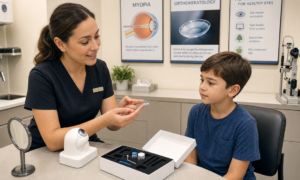
SAN FRANCISCO — The American Medical Association (AMA) recently passed a resolution backing formal classification of myopia as a disease—including by the Centers for Medicare and Medicaid Services. The goal is to ensure children and adolescents have access to appropriate treatments and insurance coverage. The resolution also calls for increased public health education and improved screening in children.
This new policy direction mirrors a global effort the American Academy of Ophthalmology launched back in 2021. The Academy alerted the world to the rising global public health crisis of nearsightedness, or myopia, with the publication of a white paper, Reducing the Global Burden of Myopia by Delaying the Onset of Myopia and Reducing Myopic Progression in Children.1 It was the first effort to coordinate a global health initiative to spread education and foster collaboration to improve treatments.
Myopia Treatments
A body of peer-reviewed research now points to several approaches that can measurably slow myopia’s advance in children and teenagers. The goal of treatment is to delay the onset of myopia in children and slow it down so the most devastating consequences of high myopia can be avoided. These treatments include:
- Essilor Stellest Eyeglasses: FDA-approved eyeglasses that can slow the development of myopia in children between 6 to 12 years old.
- Soft Contact Lenses: FDA-approved “multifocal” contact lenses for children with myopia, worn from 8 to 12 years old. These lenses are worn during the day and discarded at night. When worn consistently over several years, they may slow the development of myopia.
- Orthokeratology (OrthoK): Hard contact lenses worn overnight for children aged 6 and older. Wearing OrthoK lenses only improves vision for a short time. Once you stop wearing the lenses, the cornea slowly goes back to its normal shape and myopia comes back. Still, OrthoK may provide some permanent reduction in myopia progression.
- Low-Dose Atropine: Eye drops for children between 5 and 18 years old. Given for two to three years, the drops are placed in the eye each night at bedtime. Evidence supports its use in East Asian children, while its effectiveness in children in Western regions is less certain and requires further study.
- Behavioral Shifts: Spending more time outdoors. Studies show that spending at least two hours a day outdoors can help slow down nearsightedness.
Getting Treatment to Those Who Need It
The trouble is that almost none of these treatments reaches the families who need it. Awareness that progressing nearsightedness is an urgent health issue remains limited among parents, teachers and policymakers alike. And even when families do learn about newer interventions, many find that insurance will not pay for them, because myopia is not consistently treated as a disease requiring treatment.
“I’m a pediatric ophthalmologist and a mom of three,” said Rupa Wong, MD, spokesperson for the American Academy of Ophthalmology. “I believe all children with progressing nearsightedness should have the same access to these treatments, just like my kids. But most parents aren’t even told that treatments exist. We hope that increasing attention on this issue will help shift the national conversation on children’s eye health. Kids’ eye health is a public health issue; it’s not a parenting issue.”
The Academy has also been working to expand access to vision screening and early intervention for children through our support for H.R. 2527, the Early Detection of Vision Impairments for Children Act. This would be the first national program to address children’s vision and eye health.
The Academy applauds these important steps towards turning a slow-moving epidemic into a national priority before another generation of children grows up seeing the world less clearly than they should.
References
- Modjtahedi, B. S. (2021). Reducing the global burden of myopia by delaying the onset of myopia and reducing myopic progression in children. Ophthalmology, 128(6), 816–826. doi.org
Read the latest myopia news here