December 2, 2025
By Kevin Chan, OD, MS, FAAO, IACMM
What is known so far?
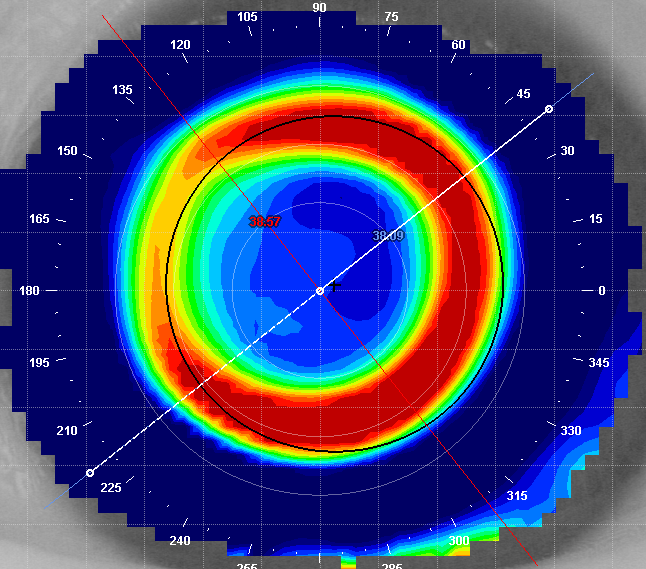
Photo provided by Dr. Kevin Chan
Orthokeratology is a non-surgical treatment modality by which reverse geometry is used to temporarily reshape or alter the cornea in a specific manner. Not only does OrthoK enable reduction of refractive error for children with myopia and help them maintain clarity without correction during daytime, growing research has shown that OrthoK can also slow or modulate excessive growth of axial length, thereby mitigating the deterioration of myopia.
While not all patients are considered good candidates for OrthoK, little is known regarding how corneal shape or other corneal mechanical factors govern or implicate the overall clinical efficacy of OrthoK treatment. A recent study by Chong et al. aimed to investigate the plausible relationships and biometrics as to whether the initial axial length to corneal curvature (AL/CR) ratio in children’s eyes could be predictive of axial length variations affected by OrthoK.
Methodology
- Retrospective study with 318 subjects aged 8 to 13 who underwent orthokeratology lens treatment for one year in Tianjin Medical University Eye Hospital, Tianjin, China.
- A total of 1,111 subjects were initially screened; 719 excluded due to loss of follow-up; 74 excluded due to exclusion criteria.
- Data was retrieved at the hospital’s Optometric Center between November 2015 and June 2018.
- Inclusion criteria:
- Cycloplegic spherical equivalent refraction (SER) of -1.00D and -6.50D Astigmatism less than 1.50D
- Best corrected visual acuity 0.00 logMAR or better
- Exclusion criteria:
- Strabismus or any ocular or systemic diseases
- No prior history of OrthoK lens wear or any other myopia control treatment
Measuring parameters
- Corneal curvature (CC) was quantified using mean keratometry (K) values.
- Axial length/corneal curvature (AL/CR) ratio was calculated as AL divided by CC and considered a baseline ocular structure.
- Axial length growth (ALG) over the one-year period was adjusted for age (aALG). It represents the difference between the measured AL and the age-expected physiological axial growth values derived from the Orinda Longitudinal Study of Myopia (OLSM) reference data.
- Summed relative corneal refractive power (sRCRP) was defined within the central 4mm zone, a measure of OrthoK-derived treatment zone.
- Associations between aALG and sRCRP were evaluated by simple slopes analysis and multiple linear regression. Johnson–Neyman technique was used to determine when the AL/CR ratio threshold became statistically insignificant.
Key Findings
- The study found that the AL/CR ratio significantly moderates the impact of corneal reshaping on axial elongation during OrthoK treatment.
- Children with lower baseline AL/CR ratios (<0.61 defined by the study) likely benefit more from OrthoK treatment.
- sRCRP can be predictive of treatment outcomes for eyes with lower AL/CR ratios.
- The results suggest that individual corneal and anatomical characteristics, particularly the AL/CR ratio, can influence the effectiveness of OrthoK for slowing myopia progression.
- Major limiting factors included, yet not limited to:
- Retrospective analysis in a single clinical setting inferred confounding biases, which likely suggested the lack of generalizability of the hypothesis for all patients.
- Corneal topography-derived sRCRP was presumed and used as a proxy for peripheral retinal defocus; however, it lacks valid translational merits since they are not always in a 1-to-1 relationship necessarily.
- The study did not account for other important factors, such as OrthoK lens wear time and compliance, time spent outdoors as well as near work habits, all of which could influence or introduce confounding impacts for the axial growth of the eyes.
- Longitudinal studies with a longer follow-up period are warranted to help substantiate the validity of the clinical findings.
Editor’s Takeaways
The findings in this study shed new insights to further our understanding in the roles of corneal biometric factors for modulating or enhancing treatment outcomes by OrthoK. In particular, AL/CR ratio can become a pivotal metric for practitioners to strategize patient selection and predict clinical efficacy of OrthoK for patients with specific corneal characteristics. In other words, if clinicians could find ways to reliably identify which patients are likely to respond better to OrthoK treatment, it would tremendously make treatment plans and outcomes more targeted and personalized for childhood myopia.
Abstract
Axial Length to Corneal Curvature Ratio Moderates the Effect of Corneal Reshaping on Axial Growth in Orthokeratology
Purpose
To evaluate the association between summed relative corneal refractive power (sRCRP) and age-adjusted axial length growth (aALG) in children undergoing orthokeratology (OK), and to determine whether this relationship is moderated by the axial length to corneal curvature (AL/K) ratio.
Methods
This retrospective study included 318 eyes of children (8-13 years of age) treated with OK lens for 1 year. Corneal curvature (CC) was quantified using mean keratometry (K) values, and the AL/K ratio was used to represent baseline ocular structure. Axial length growth (ALG) over 1 year was adjusted for age (aALG). sRCRP was derived from 1-year axial maps within the central 4 mm. Associations between sRCRP and aALG were assessed by multiple linear regression, with moderation assessed via interaction terms, simple slopes analysis and the Johnson-Neyman technique.
Results
The mean sRCRP was 19.39 ± 10.29 D·mm2 and the mean aALG was -0.07 ± 0.21 mm after 1 year. Multivariate regression showed that sRCRP (β = -0.01, p < 0.001), baseline AL (β = -0.09, p < 0.001) and spherical equivalent refraction (β = -0.02, p = 0.03) were significant predictors of aALG. A significant interaction between sRCRP and AL/K ratio (β = 0.10, p = 0.01) indicated that the effect of sRCRP on aALG varied with baseline ocular structure. Johnson-Neyman analysis revealed that sRCRP was significantly associated with reduced aALG only when the AL/K ratio was below 0.61.
Conclusions
The AL/K ratio moderates the relationship between sRCRP and myopia control efficacy in OK lens treatment. sRCRP is predictive of treatment outcome primarily in eyes with lower AL/K ratios, supporting the role of biometric profiling in guiding individual OK lens strategies.
DOI: 10.1111/opo.70036